
The summertime temperatures are cool here in the East Bay, at least this side of the Caldecott Tunnel whose narrow bores cut through Berkeley Hills and mark the transition between the heat of inland cities and the lingering fog of those running the coastline. I write by the warmth of a single lamplight, enveloped by darkness outside. With the shades dropped to escape the triggering of neighboring IoT, the darkness is something I know but do not see. If not for the sounds of harassment stirred by the excessive churning of the refrigerator compressor and the whirring of its fans, the occasional hissing voice that sounds at the windows telling me “Leave!” or the ringing in my ears, these hours would be contemplative, they would be quiet.
It’s hard to imagine that I’ve lived with this for so long. But when you’re victimized by a predatory crime whose perpetrators escape prosecution by victimizing people in their homes and defaming the victims who report and resist, there aren’t a lot of choices. Who would I be if I let criminals harass me out of my home? This is how I tried to explain it early on to those who should have helped me, but when your circumstances are not believed, your response to those circumstances is irrelevant. When criminals defame their female victims as delusional and the police and court personnel are so ill-trained, biased, or corrupt as to accept their defamation as fact, women who care about the legal regard for their competence, self-determination and agency are left with few choices than to suffer the harm of tech-enabled harassment. Frederick Douglass said, “The limits of tyrants are proscribed by the endurance of those whom they oppress.” When cities like Seattle, Washington and Albany, California ignore the predatory crimes that are instigated and supported by their police-installed neighborhood watches and block coordinators, it is only through endurance that women might right the wrongs done them. And yet no one should have to endure being battered in her home.

These screenshots, upper and lower, were made from an Airtool capture reviewed in the Wireshark application and show just a few of the devices that were active within range of the Albany house during audible, and even palpable, harassment. From screen to screen, I’ve covered the octets of the MAC addresses that are specific to the network interface controllers of the individual devices.

My last entry, Pictures from a mobbing, included a screenshot from the Eye P.A. WiFi analysis application that showed an SSID in Seattle with three TP-Link clients. As mentioned in that entry, TP-Link makes a range of network devices, including smart plugs, WiFi routers and extenders, and powerline adapters that can be used in access point mode.
In addition to the TP-Link device, the screenshots show Amped Wire and 2wire devices. One Amped Wireless flagship device is the universal Amped Wireless High Power AC1200 Plug-in Wi-Fi Range Extender, “equipped with a total of eight amplifiers and two high gain, dual band antennas to provide up to 11,000 sq ft of fast Wi-Fi coverage.” The device includes a gigabit wired port for bridging wired devices like smart TVs, pass-through power and USB charging. Like many extenders now on the market, the REC22P is designed to extend coverage to exterior as well as interior areas and given a coverage area of 11,000 sq ft, that may well include the neighbors (https://ampedwireless.com/rec22p.html).
The 2Wire vendor OUI is interesting in a situation where an illicit powerline connection is likely because the company, defunct in 2010, is associated with AT&T and home networking standards. like HomePNA (Home Phoneline Networking Association). 2Wire’s MediaPortal, distributed by AT&T to support its Homezone service, included a set-top box combining television, DVR, music, messaging and more. 2Wire’s MediaPoint Digital Medial Player, delivered to market in 2008, was a set-top box that sourced content from the home computer network. Pace acquired 2Wire in 2010; I don’t know if the 2Wire vendor OUI continues to mark new devices.

This NetSpot survey shows the device manufacturers for the SSIDs (service set identifiers) within range during the same period of time. The “Dobby is a free elf” SSID and the three hidden SSIDs above are associated here with the vendor Technicolor. At the Seattle house, the Pow-Pow SSID united four Eero appliances (Mobbing by WiFi range extender). For some reason, I had been thinking these were Eero access points in Albany; I’ll have to go back and check to see if I misread or referenced the vendor OUI or if there was some configuration change along the way. The screenshot above displays the SSIDs by channel; a printer with the Hewlett vendor OUI shares channel 6 with the Technicolor interfaces.

The screenshot above was taken from a NetSpot heat map showing the signal level at the charted points in the interior of the Albany house. The left side of the image is the north side where the residential infrastructure that remains, including the PG&E electric meter, is affixed to the house. The electric meter is somewhere between the first and second points running from the bottom of the rendering along the north side of the house.

Last time I counted, the slider revealed information for at least seven access points.

That included some Xfinity access points like these.

I’m starting to wonder if this access point represents the household refrigerator, which my relative remarked made strange noises. It does. The refrigerator, which is not “smart” and should not be part of an IoT ecosystem, can run continuously during periods of aggressive harassment; the refrigeration cycle and its displacement of air seem to play a key role in distributing harassment. In this house, the central heating does the same.

This rendering shows the physical mode of the bandwidth in the house. This screenshot was also taken from a survey during this last week, a couple of months since I changed out the router to one that does not support WiFi.

This Eye P.A. analysis shows that the Amped Wireless device is a client of the 2Wire device.

The Dobby is a free elf SSID has two Technicolor clients.

Dobby also has a high retransmit rate. A high retransmit rate seems pretty common both in the environment of the Seattle house and that of the Albany house and is sometimes up to 100%. Retransmits indicate network congestion. Too many access points sharing the same channel can cause cross-channel interference.
The use of WPS is another common feature in the environment of the Albany house. WPS was introduced in 2007 to help non-technical users set up protected access to their networks by PIN or router push-button. The standard has been abandoned and users with more than rudimentary knowledge of WiFi or users who are simply reading an informational page on how to configure a router know that WPS should not be used. WPS does, however, make it easy to add devices, including rogue devices, to a network. WPS is commonly used to establish connections between WiFi extenders and routers.
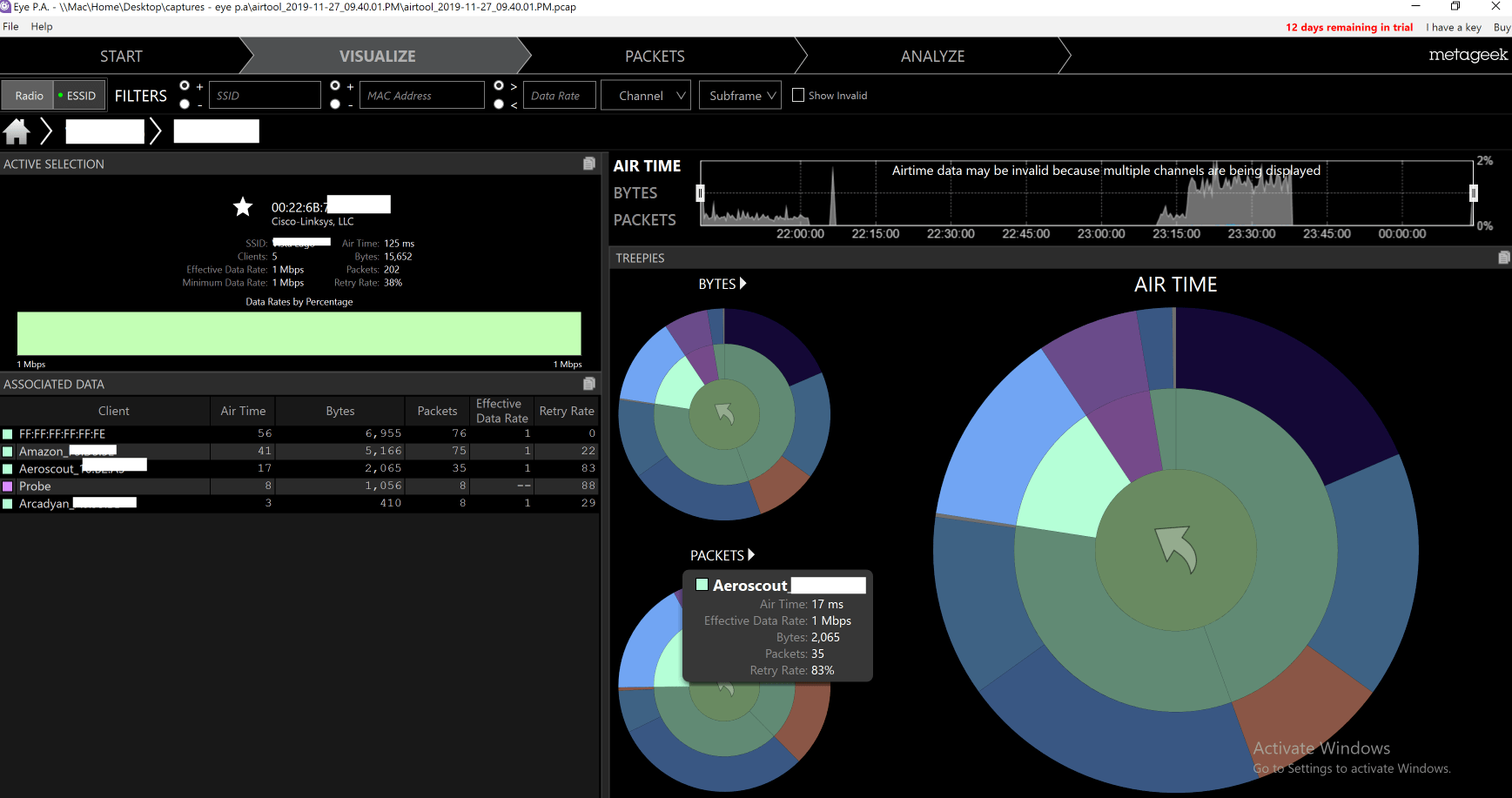
The higher retransmit rates become obvious with the use of tools like Eye P.A. I started noticing it immediately after beginning use of the tool, when Eye P.A. also identified the MAC address of an Aeroscout drone that was the client of an SSID whose two-word friendly name was the transposed reading of the Seattle ID noted to have three TP-Link clients in Pictures from a mobbing. The Aeroscout seemed to be prominent during a time when one of the Seattle mobbing houses was undergoing major renovations and appeared to be uninhabitable.

2 responses to “Pictures from a mobbing (part 2)”
[…] Pictures from a mobbing (part 2) […]
[…] When “investors” leverage a business plan of “surrounding” a victim dwelling with malicious networks that encroach over the property line onto victim infrastructure, appliances and devices, we shouldn’t be blind to their handiwork. Maybe we can’t see the abandoned piping they command or the entry point they use to thread snakes into the sewer lateral, but there are tools we can use to get information about their rogue networks (Pictures from a mobbing (part 2)). […]