

An illustration of the Edison Torch Light Parade of 1880 through the streets of Manhattan
The incandescent promise of the 20th century was heralded not by the wire–the copper conductor used in knob-and-tube or open work–but by the bulb, the Edison light bulb. Thomas Edison’s incandescent bulb would come to signify the luminance of the modern home.
The incandescent bulb, also called a filament light bulb, was a refinement made possible with decades of experimentation by a succession of inventors. Edison’s bulb used a carbon filament (“Edison light bulb,” in Wikipedia at https://en.wikipedia.org/wiki/Edison_light_bulb).
Britain’s Joseph Swan had created a workable design for the incandescent light bulb in 1878. But his, using platinum for the filament, was too expensive to commoditize. The history of the electric lamp shows attempts to create an illuminated vessel dating back to at least the 1840s. From the start, the focus of the experimentation was the search for a conductor that offered the appropriate electrical resistance, durability, and cost.
Ω
The Edison bulb was put into production and commercially available before the end of 1879. The infrastructure required to use it, however, was not. Edison would base the distribution system for electric lighting on that used for gas lighting. Electricity would be centrally generated and stored for distribution. Distribution would be effected over conductive copper wires in tubes called conduits. Consumption would be monitored by utility meter. Edison received a patent for his electric meter in 1881 (“The history of the electric meter,” Smart Energy International, https://www.smart-energy.com/features-analysis/the-history-of-the-electricity-meter/).
Swan sought to make a filament from a material more affordable than platinum. He experimented with carbonized paper but the soot tarnished the luminance of the glass vessel. Eventually, Swan arrived at a design that used cotton thread (“Shedding light on lightbulb history: who actually invented the incandescent lightbulb?” in Interesting Engineering at https://interestingengineering.com/science/who-actually-invented-the-incandescent-light-bulb). Swan patented his design in England in 1879; Edison’s American variant emerged in 1879 and was followed by his January 1880 patent application for an “electric lamp” (“Thomas Edison’s Patent Application for the Light Bulb” (1880), in the National Archives at https://www.archives.gov/milestone-documents/thomas-edisons-patent-application-for-the-light-bulb). The formation of General Electric as a merger between the companies of the two inventors came after Swan’s patent superseded Edison’s in a legal challenge (“The History of the Light Bulb,” The Department of Energy, https://www.energy.gov/articles/history-light-bulb).
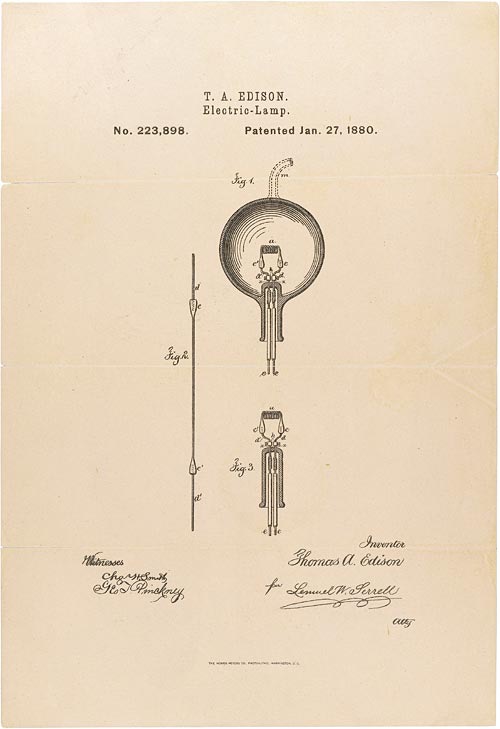
Thomas Edison’s drawing of his “electric lamp.” This drawing was part of the application he submitted to the United States Patent and Trademark Office and part of the holdings of the National Archive
However awestruck by the incandescence of the Edison bulb that burned without soot and noxious smells, the drive to electrify America was not without hazards. Workmen installing the New York City distribution system were electrocuted; horses were shocked when their hooves fell on wet pavement. The uncertainty did nothing to allay the fears of a public resigned to the dangers of gas lighting. To drum up support, Edison created spectacles of light. In one of these, the “Electric Torch Light Parade,” 400 Edison employees marched through the streets of Manhattan, each with a lit bulb strapped to the head and a conductor down the sleeve, drawing a dynamo behind them.
The value of gas stocks declined with Edison’s announcement of a viable electric lamp. But gas would not give up its hold so easily. The industry responded by improving the quality of the gas and introducing an incandescent mantle. The result was better gas light.
Edison sought to compete with an established industry that had customers and infrastructure well built out. Not to mention the fact that gas could be used for heating and cooking while Edison’s fuel change would provide only illumination (“Lighting a Revolution: Competition to Edison’s Lamp,” Smithsonian National Museum of American History, https://americanhistory.si.edu/lighting/19thcent/comp19.htm). It would take decades of technological development and electrification before electric illumination took hold.
Ω
In 1802, Sir Humphrey Davy became the first to create electric light. In Davy’s experiment, the ends of two carbon rods were positioned to touch. Upon ignition—the strike—the rods were separated, leaving a high-intensity “discharge arc” to burn at the gap. This was the carbon arc light. The strike was fueled by the continuous current from a voltaic or “wet pile” battery (“Arc lamp,” in Wikipedia, https://en.wikipedia.org/wiki/Arc_lamp). The battery was the first source of continuous or “current” electricity (SciencePhoto Library, https://www.sciencephoto.com/media/1002863/view/alessandro-volta-s-wet-pile-battery-1800).
Invented by Alessandro Volta in 1800, the Voltaic Pile was composed of alternating discs of two different metals—in this case, zinc and copper—separated by cardboard and soaked in a chemical brine. The wet pile battery marked the first practical method of generating electricity (“History and Timeline of the Battery,” https://www.thoughtco.com/battery-timeline-1991340 and “Voltaic pile,” in Wikipedia, https://en.wikipedia.org/wiki/Voltaic_pile). Continuity of current would transform civilization.

An illustration of an early carbon arc light using a voltaic battery like Davy’s. Image via Wikipedia, from Augustin Privat Deschanel 1878 Elementary Treatise on Natural Philosophy, Part 3: Electricity and Magnetism, D. Appleton and Co., New York, translated by J. D. Everett, p. 702, fig. 509 on Google Books
The carbon arc lamp is the progenitor of the gas discharge lamps that were the subject of experiments by Edison and Nikola Tesla in the 1890s. The carbon arc lamp that Davy created was a type of gas-discharge light. Davy, a chemist and pioneer in electro-chemical interactions, investigated a range of gases, giving nitrous oxide the common name of “laughing gas” after his own explorations with inhaling the substance. Davy later created a safety lamp that would be named for him; the Davy lamp saved countless miners from the explosive mix of candle light and underground methane gas.
The “wet cell battery” had allowed for the reliable and continuous current that enabled Davy’s carbon arc lamp. Continuity across greater intervals of time and space would require the development of the electric generator and distribution grid. The role of the battery would be power store.
Electrodes are the core of a battery. Batteries generate electrical charge through an electrochemical process (“Electrode,” in Wikipedia, https://en.wikipedia.org/wiki/Electrode). An electrode is a solid electric conductor that transmits electric current into substances that are not metal, including liquids, gases, plasmas and vacuums. In an electrochemical cell like a battery, electrochemical reactions take place at the electrodes and current moves between them.
Davy’s arc light used carbon electrodes. The lead-acid batteries in your gas-ignition car create the low-voltage charge required to turn over the engine using lead electrodes. Battery technology is fundamental to the harnessing and use of energy.
The term battery was first used by Benjamin Franklin in 1748, to refer to an array of charged glass plates (https://www.thoughtco.com/battery-timeline-1991340). The development of the battery as a source of continuous power played a critical role in an electrification that continues even now, moving American society from gas to grid. Key developments in this shift that stretches beyond fuel change to cultural change, started with the telegraph and telephone, ignition systems, and the evolution of the transistor into the computer, the mobile phone, and the electric vehicle.
The continuing improvements in battery technology give the storage of electricity an importance on par with its distribution. In the 21st century, the rise of the battery as a form of ready power, the home generation and conversion of DC current, and easy-access low-voltage electrical systems, provide a rich ecosystem for house mobbing.
Ω
Electrification transformed industry and institution, and even the system of American capital punishment. The replacement of the scaffold with “the chair” was put into motion in the early 1800s with Humphrey Davy’s design of the arc lamp. With the installation of arc lighting in the late 1870s through the early 1880s, accidental death by electrocution hit a peak; linemen were the usual casualties of an electrical supply that ranged from 3,000 to 6,000 volts. One unusual death occurred in 1881 when an inebriated dock worker sought to relive the thrill of a lesser charge from a guard rail at the arc lighting power house of Brush Electric Company in Buffalo, New York. Returning to the plant at night, the dock worker held the brush and ground of an electric dynamo in hand. He died instantly.
The speed of the death was noticed by proponents of a capital punishment more “humane” than hanging, including Alfred P. Southwick, a dentist who designed the lethal appliance as a modified version of the dental chair (“Electric chair,” in Wikipedia, https://en.wikipedia.org/wiki/Electric_chair). The prototype was a wooden chair with electrodes intended to be affixed to head and leg for delivery of the mortal shock. By 1888, a New York State commission opted to modernize capital punishment with the “electric bolt in place of the rope” (“The Fatal Current: Electrocution as Progress,” in JSTOR Daily, https://daily.jstor.org/the-fatal-current-electrocution-as-progress/). In the history of progress, the electric chair was to be America’s guillotine.
Capital punishment became the arena for new battles in the “Power Wars” as Thomas Edison and George Westinghouse sought to use the debate to their own advantage. This despite their shared opposition to execution by electroshock. When Westinghouse refused to allow an alternating current (AC) generator to power the death device, Edison dispatched his team to locate a Westinghouse generator, suggesting that death by the chair be dubbed “Westinghousing.” (“A War of Currents’: The Real Story of Thomas Edison and the Invention of the Electric Chair,” https://www.magellantv.com/articles/a-war-of-currents-the-real-story-of-thomas-edison-and-the-invention-of-the-electric-chair).
Edison campaigned for an electric chair powered by alternating current (AC). He sought to take advantage of the fears of electricity that were stirred by the many casualties during the rollout of electrical infrastructure. With any luck, he could stoke the fears of the public and tie those fears to the AC voltage of his competitors (“The Fatal Current: Electrocution as Progress?” in JSTOR Daily, https://daily.jstor.org/the-fatal-current-electrocution-as-progress/). Westinghouse hired a defense team for the convicted murderer who would be selected as the chair’s first victim. The defense would argue that the death by electrocution was cruel and unusual punishment.
The first use of the electric chair extended to eight minutes and could not be said to be “humane.” A second electroshock was required to finish the job but could not be administered until the generator recharged. George Westinghouse later commented, “They would have done better using an axe.” The most recent case of death by electric chair in the U.S. was in February 2020, in Tennessee. Over the course of the 20th century, multiple shocks have regularly been required to end the lives of prisoners in those states where death by electroshock prevailed. For Nicholas Todd Sutton, electrocuted in in Tennessee in 2020, it took two (“Tennessee execution: Nicholas Todd Sutton executed by electric chair,” archive.today for Tennessean, https://archive.ph/20201019151500/https://eu.tennessean.com/story/news/crime/2020/02/20/nicholas-todd-sutton-execution-tennessee-electric-chair/4806710002/).

The “humanity” of state-ordered execution in the electric chair is measured by its efficiency. One shock is punishment by death; repeated shocks are torture.
Ω
The modern home comes with all the electrical components required for the administration of electrical torture. As I’ve noted elsewhere in On being mobbed, a Berkeley electrician once told me that some were using generators to harass others. In mobbing, generators and pumps are catalysts in the creation of “enhanced” domestic punishment. The malicious use of sump pumps on or adjacent to your property, for example, appears to be fundamental to monkeywrenching your plumbing and could well have figured in the events that led to a plumbing leak in the basement of the Albany house, the collapse of my mother’s lung, and the lung disease that determined the manner of her death.

The class of appliances I refer to as “generators” is necessarily broad because I cannot be sure of what a criminal investigation will confirm. Different types of generators appear to be in play, including generators of electrical, heating and cooling processes. Generators are critical to communications on battlefields of all kinds, digital and otherwise. “No comms, no bombs!” as mobbers with backgrounds in the military or militia might say. It might be that in a living-off-the-land attack on a knob-and-tube electrical system, or perhaps any electrical service at all, the injection of DC power from a generator incites unpleasant reactions.
AC power courses through the walls of our homes, bringing current to appliances and devices that rely on DC motors, capacitors and batteries. Transformers convert AC power to low voltages for efficient lighting and doorbell notification. High-efficiency lamps illuminate into brilliance by current moved across spark-gapped electrodes.
I’ve learned that there are generators on the market that can create WiFi hotspots. I’ve read that it’s difficult to detect DC riding atop AC. I’ve captured network frames showing the use of power line technology in my environment. I’ve mapped the deployment of wireless access points used around me.
When mobbers in Seattle, Washington and Albany, California deliberately boost radio frequency and DC power, and when they charge across the circuits of victim houses, they add heat, they create interference. Mobbers monkeywrench. Mobbers create mayhem. This is how they evict. Knob-and-tube, a wiring system that lacks a ground, can only make it easier.
Battery technology plays an increasing role in the numbers of those shocked and burned and in the fires caused by overheating devices, appliances and vehicles left unattended or run amok. DC battery current often supplies the charge in electrified human torture, from the picana to the stun gun (The mobbers’ “World Wireless System” and hate culture in Albany, California (part 2)). An automotive battery charges the picana, an antecedent of the cattle prod designed by Nikola Tesla. In this case, the low amperage “allows the repeated use of shock without killing the victim” (Electricity: The global history of a torture technology, by Darius Rejali, Professor Emeritus of Political Science at Reed College). The cattle prod is a cylindrical stick, one end bearing a pair of electrodes capable of transmitting a high-voltage, low-current electric shock to skin (“Cattle prod,” Wikipedia, https://en.wikipedia.org/wiki/Cattle_prod).
Stun technology was developed in the United States in the 1980s and 1990s (“Arming the Torturers: Electro-shock Torture and the Spread of Stun Technology,” https://www.amnesty.org/en/wp-content/uploads/2021/06/act400011997en.pdf). The stun belt, an application of stun technology, remains in use in the United States. According to Amnesty International, “Among electro-shock weapons, the use of the stun belt, even when not activated, violates
international human rights law” (“USA: The stun belt — cranking up the cruelty,” https://www.amnesty.org/en/wp-content/uploads/2021/06/amr510861999en.pdf).
A stun belt is wound about the prisoner’s waist or a limb to position battery and control pack against the skin. Electroshocks are administered by remote control to the control pack. In contrast to the use of torture in interrogation where a subject might be threatened with shock if he fails to talk, in some courtrooms the subjects have been threatened or shocked for talking out of turn or failing to convincingly listen.
The benefit of the belt is that it provides restraint without “manpower” according to Amnesty International. In “Shocking Discipline,” an article published in Mother Jones (March 1, 2000), Barry Yeoman recounts the story of a California defendant whose courtroom judge ordered the administration of a shock when he interrupted her one too many times (https://barryyeoman.com/2000/03/shocking-discipline/). Jack Brook of the Marshall Project writes of Judge Jack Sheen’s ever-present threat to order the delivery of a 50,000 volt charge to defendant James Calvert. The Court eventually made good on the threat when Calvert could not follow the judge’s instructions to stand to speak and to sit when done (“Stun belts are intended to keep control in courtroom, but some judges use them to inflict punishment,” American Bar Association Journal (ABAJournal), https://www.abajournal.com/news/article/stun-belts-are-intended-to-keep-control-in-the-courtroom-but-some-judges-use-them-to-inflict-punishment).
In these cases, the state is implicated in the remote administration of the electric shock, and the body of prisoner becomes the site, “the anchoring point for a manifestation of power” (Discipline and Punish: The Birth of the Prison (1977) by Michel Foucault). The use of electricity in punishment is part and parcel of America’s electrification whether the shock is administered from the electrodes of an automotive battery or across an ungrounded knob-and-tube circuit. From their houses scaffolded with monitoring and motion detecting devices that should be turned on them, and in their overlay attacks that apply rogue electrical and charging processes alongside the malicious use of wireless protocols, mobbers create invisible prisons—the traveling mattes their victims are left to traverse. For the victims of mobbing that cities refuse to acknowledge, civil rights—even human rights—are nothing but false promise; the grid little more than electric fence. We wear these systems, these fuels, charges and flows we call utilities, on the skin that stretches across our bodies. With them, we are imbricated into earth, into ground.
Ω
It is a noteworthy fact in human experience
that agencies and forces which have been devised
and utilized to promote the most beneficent ends
possess possibilities of the gravest harm
together with the power
to enhance man’s comfort and convenience.
–Dr. F.W. Draper, Boston Medical and Surgical Journal, 1983.
The force F.W. Draper wrote about in the Boston Medical and Surgical Journal was illuminating gas. The year was 1893. The Edison bulb had been demonstrated only a few years before but electricity remained off the table for all but the most affluent. Electrification would require extensive retrofit coupled with planned installations in new buildings. In 1915, only eight percent of American homes had electricity (“Early Electrical Wiring Systems in American Buildings, 1890-1930,” by LaLuce D. Mitchell, APT Bulletin, Vol. 42, No. 4 (2011), pp. 39-45). The drive to electrify America would not come until after the Great War.
The northeastern American coast depended on illuminating gas. It was a costly dependence. In West Hartford, Connecticut alone, eight people lost their lives to illuminating gas between 1900 and 1912 (“The danger of illuminating gas,” https://www.ctexplored.org/the-danger-of-illuminating-gas/).
Patrick and Ellen Broderick were Irish immigrants who came to America in 1860. They settled in Hartford and raised their children. When they got old, they moved to West Hartford and settled into St. Mary’s Home for the Aged. The facility opened in 1896 with gas lighting installed. But gas light fixtures required tending that could only be more difficult with age. Fixtures had to be manually turned on and off. If there was a brief interruption in the gas flow, intervention was required to relight the fixtures or stop the flow of gas. This alone accounted for the many deaths that occurred when brief outages were not noticed or victims were in slumber. In “The Relation of Illuminating Gas to Public Health” (Journal of American Public Health Association, 1910), MIT professors W.T. Sedgwick and F. Schneider reported “… in the northern tier of states, gas poisoning is today a very serious cause of sickness and death” (“The Danger of Illuminating Gas,” Connecticut Explored, https://www.ctexplored.org/the-danger-of-illuminating-gas/).

The title page of another tomb from the Industrial Era, by H.S. Norrie (Norman H. Schneider), author of Wiring Houses for Electric Light. H.S. Norrie wrote a library of scientific manuals on topics including induction coils, wireless telegraphy, and batteries
The Brodericks died of asphyxiation by illuminating gas. In their case, the gas-fueled light fixture in their room was faulty (“The Danger of Illuminating Gas,” Connecticut Explored, https://www.ctexplored.org/the-danger-of-illuminating-gas/). The couple were 85 and 74 years of age, old enough to have frailties that could have made them more vulnerable or unable to perform the necessary oversight.

It was September 1913; a year before the outbreak of the Great War but, with the Armory Show, the dadaists had already invaded. (What would Marcel Duchamp have done if he were mobbed?) The Sixteenth Amendment was passed to allow the collection of taxes. And the Hetch Hetchy Dam was authorized and filled, making a reservoir of a waterway.
The public recognized the danger of illuminating gas. The fact that half of the deaths from the flickering light were suicides could only underline the public awareness of its lethal potential. The risk increased in proportion to the volume of carbon monoxide in the gas, and in the United States where water gas was used in greater concentrations, the deaths increased too.
Ω
Water gas is a fuel gas, a gaseous fuel that is easily transported through pipes (“Water gas,” https://en.wikipedia.org/wiki/Water_gas, and “Fuel gas,” https://en.wikipedia.org/wiki/Fuel_gas, in Wikipedia). This is exactly the kind of gas that would be attractive to mobbers who think no one will be the wiser if they propel toxins into their neighbors’ plumbing lines. Water gas—archaically known as hydrocarbonate and composed of carbon monoxide and hydrogen—was investigated for its anesthetic properties in the 18th century. Pure coal gas was estimated to contain 6 to 8 percent carbon monoxide, whereas the content of carbon monoxide in water gas was assessed to be 40 percent (“Poisoning by Illuminating Gas,” March 3, 1923, in Nature, No. 2783, Vol III, p.294). Hydrocarbonate was a source of interest for Humphry Davy, inventor of the carbon arc lamp, who later described how he sunk into “annihilation” and almost died after inhaling three quarts of the substance.
The American self-made scientist Thaddeus S.C. Lowe was instrumental in the use of water gas in American homes, in 1873 developing a process that could generate the quantities of hydrogen gas required to meet residential and commercial demands. This innovation was directly responsible for the growth of the American gas industry and gasification plants sprung up across America’s eastern seaboard. But the dangerous composition of American water gas was a matter for discussion in Nature:
The Departmental Committee on the Manufacture and Use of Water Gas, 1899, recommended that the Board of Trade should have the power to limit the proportion of carbon monoxide in illuminating gas to 12 per cent. [sic] or such higher value as should be considered safe. The Departmental Committee on Carbon Monoxide, 1921, reported ‘that it is not necessary or desirable to prescribe any limitations of the proportion of carbon monoxide which may be supplied in gas used for domestic purposes,’ though a suggestion was considered that a limit of 20 per cent. of carbon monoxide might be imposed.
Nature notes that water gas was often added to pure coal water for reasons of economy, sometimes as much as 50 percent, resulting in distributions of illuminating gas containing as much as 20 percent carbon monoxide (p. 294).
Carbon monoxide results from the incomplete combustion of fuels that contain carbon. Carbon monoxide is generated by human action as well as natural events like forest fires. Mark Porch, professor of Science Communication and Chemistry at the University of Hull, explains that the carbon monoxide binds more strongly than oxygen to hemoglobin—200 times more strongly—interfering with the binding of oxygen to hemoglobin and thereby limiting the transport of oxygen through the body (“Carbon monoxide: what is it and why is it deadly?” https://theconversation.com/carbon-monoxide-what-is-it-and-why-is-it-deadly-186949). The result is the “early symptoms” of carbon monoxide poisoning like headache, tiredness, dizziness, breathlessness, pains in the chest and stomach, and visual disturbances. These facts make me wonder whether the intention of the north mobbing house owner in Seattle was only to frighten me when, intended for my hearing, he speculated on how close he would have to position a generator to my windows to kill me. Carbon monoxide poisoning from a generator is feared equally. This overhearing is documented in a post on this blog written much earlier, before I understood even as much as I do now about what people who “mob” are prepared to do to others. If he is using a generator (in addition to the exudate of his exterior air-conditioning unit), it may be gas-fueled.
Water gas is commonly described as being created by “blowing a fuel layer [coke] with air and gasifying it with steam.” This description along with the ingress through pipe, window and wall of what seemed to be burning fuels led me to do a bit of searching on the feasibility of making hydrogen—water gas—in the backyard. Apparently hydrogen is becoming an alternative fuel for the backyard grill-man (https://www.h2grills.com) and how-to treatments on making hydrogen at home are easily found. The process also yields some nitrogen gas.
Professor Porch’s article contrasts carbon monoxide with carbon dioxide, another yield of the combustion process. Carbon dioxide is comparatively nonreactive and nontoxic. Nevertheless, carbon dioxide is an asphyxiant gas that can displace the concentration of oxygen necessary to sustain human life (“Asphyxiant gas,” in Wikipedia, https://en.wikipedia.org/wiki/Asphyxiant_gas#cite_note-9). Asphyxiant gases, like the poison gases that result from incomplete combustion, might be seen in the release of gases during volcanic eruptions or other outgassings, for example, the 1986 release of an estimated 100,000 to 300,000 tons of carbon dioxide at Lake Nyos in Cameroon (“Lake Nyos disaster,” https://en.wikipedia.org/wiki/Lake_Nyos_disaster ). That outgassing reportedly killed the 1,746 people and 3,500 livestock within 25 kilometers of the lake. Some displacements are environmental, for example, the displacement of oxygen by carbon dioxide in a mine or a “confined space”— perhaps even a basement. The Center for Disease Control (CDC) distributes warnings on the use of generators fewer than 20 feet from your home (“When the power goes out, keep your generator outside,” https://www.cdc.gov/carbon-monoxide/media/pdfs/Generators_1.pdf). What happens when the property line you share with a mobber is no further away than 10 feet?
Helium is another asphyxiant gas that can pose a significant risk, for example, during the “magnet quench” of a magnetic imaging machine or in an exposure that occurs in an inflatable balloon. That brings to mind what it is that the lowlife on the north side of the Albany house use to blow up the inflatables they display so prominently for Halloween and Christmas. During these holidays, the mobbing abuse carries all the more easily with the radios and lights that accompany the inflatable “gear” and something noxious that makes the chest tighten seems to be in the air and is strengthened with the cycling of the refrigerator. In the days of illuminating gas, the suicidal found an assist in carbon monoxide. Some prefer the use of asphyxiant gases like helium.
In the inert gas group, helium is widely used to commit suicide, due to its characteristics and accessibility. It is an odorless, colorless, and nonflammable gas used to inflate balloons, which makes it extremely easy to get.
(“Helium Suicide, a Rapid and Painless Asphyxia: Toxicological Findings,” in NIH: National Library of Medicine, https://www.ncbi.nlm.nih.gov/pmc/articles/PMC9412544/.) An additional appeal for some might also be that the exposure to helium might escape detection in postmortem examination.
Suicide by helium inhalation has become increasingly common in the last few decades in Europe and the US because it produces a quick and painless death. Inhaled-gas suicides can easily be assessed through death scene investigation and autopsy. However, helium is a colorless and odorless inert gas that unfortunately cannot be detected using standard toxicological analysis.
The 64-year-old American woman who this month (September 2024) became the first to use the “Sarco suicide pod” in the woods of Merishausen, Switzerland ended her life with the displacement of oxygen by nitrogen gas (https://www.cnn.com/2024/09/24/europe/switzerland-arrests-sarco-suicide-capsule-intl-hnk/index.html).
Ω
Sometime back I paused and then passed over some guy’s question in an online forum. It went like this: “Say, what’s with contractors blowing air between the floors of nearby houses?”
It didn’t sound like it was what was happening to me, and the question was devoid of the kind of detail that would have made it seem applicable to my situation. But air flows with the utilities that are channeled in and out of our homes, these flows that include currents of electricity, water and natural gas and that bring us warmth, light and sound. These flows have their own physics, as do the materials we use to contain them, to transport them, and to store them. Electrical current is the “carrier current” for radio frequency created in power line technologies. Currents of air are a primary carrier for sound. Currents in electrical conductors create magnetic fields in and around the conductors. This is the “skin effect” that travels with them (“Skin effect,” in Wikipedia, https://en.wikipedia.org/wiki/Skin_effect). When galvanized pipe becomes conductive, it is a carrier. When the mobbers tell you they’re “in the wind,” as they did me, they try to blind you with science. This is the lore they try to create for themselves. This ethic of superiority—the psychopathological need to use science, technology, and military strategy to bend you to their will—tells you who they are and where to find them. But as in science, the causes and effects of sabotage are all too real. Even if “all” they do is find some abandoned plumbing line close to the property line and pump the water out of your plumbing traps or pump air backward into your plumbing from the sewer lateral, they obstruct the flows that are designed to keep your home healthy and safe (I recall the time Roto-Rooter told me there was no clog after my mother and I saw soapsuds we hadn’t made coming from the location of the sewer line in the parking strip). Even if “all” they do is burrow under your foundation and pump air upward, they crack and destabilize your foundation. Even if “all” they do is blow air through your heating ducts, they block the venting of dangerous emissions and send toxic gases back to you. If mobbers shoot air into your home, it’s probably a strategy in a living-off-the-land attack intended to “leave no trace”—no artifact of intrusion, no forensic. Flows of air are not inert. Air is a breeze, and air is a hurricane.
Gases “flow” in and out of our homes. Carbon monoxide is a product of the use of natural gas fuels. Carbon dioxide is a component of sewer gas. In the same years when Edison demonstrated his light bulb and illuminating gas found distribution to American homes through a system of piping, physicians cautioned the public on sanitation. Louise Harvey MD of Los Angeles, California wrote:
To the drainage of the house too much attention cannot be paid. The plumbing is best placed entirely outside the main part of the house, and separated from it by an air space into which the sunshine and air have free access…. Many people are obliged to live in houses where the lavatories are enclosed in the main part of the house, or, as Dr Price puts it, ‘in enlarged water-closets.’ To these people we would say that much may be done to obviate their contaminative influence, first by keeping the plumbing in perfect condition; second, by keeping the bowls and traps clean, and third, by ventilation…. Every householder should have a plan of his house drainage in order to facilitate the finding of faulty pipes or joints….”
(“Excerpts from The Transactions of the Medical Society of the State of California 1898, in NIH: National Library of Medcine, “The insidious foe”–sewer gas,” https://www.ncbi.nlm.nih.gov/pmc/articles/PMC1275984/.)
The 19th century fears of the sewer and what lies within brought about a movement of “sanitary reformers” and the invention of sewer traps. As Edwin Chadwick, one of the leaders of the sanitary reform movement, put it, “[A]ll smell is disease.”
A sewer trap is a portion of a plumbing line that introduces a bend below or within a plumbing fixture. The bend, typically described as a U, S, Q, S or J trap, creates a low point that retains water after each use of the plumbing fixture. For example, the p-trap under your sink that clogs from time to time but from which you might be able to retrieve a ring you’ve dropped down the drain. Traps are specified in building codes; in different regions of the United States, different traps may be specified (“Trap (plumbing)”, in Wikipedia, https://en.wikipedia.org/wiki/Trap_(plumbing)). When you hire a plumber, when a general contractor does plumbing, and when a housing inspector examines new plumbing, an understanding of the correct way to run a trap and line is part of what we pay them for. When, like my mother, you have a bathroom remodeled by a general contractor with no useful trapping that decades later causes a licensed plumber to shake his head, you’ve got a remodel that was not only poorly executed but may not have been inspected. The same holds true when, like my mother, you have the kitchen remodeled and the general contractor puts that coveted stretch of new kitchen cabinets on top of the air intake for the gas furnace. In this case, the HVAC specialist I hired to begin isolating the disabled gas furnace from the venting that was being used to distribute mobbing throughout the house shook his head and commented, “It wasn’t inspected.” That finding explained the “short cycling” of the furnace I noticed when my mother still lived here—the process of the furnace automatically shutting it off because of the poor heat dissipation, and then coming on again after the thermostat detected the cold. This condition was a fire hazard.
Some traps that are no longer permitted in new construction in some parts of the United States include “S” traps that are easily “siphoned” dry under negative pressure in the drain pipe. Plumbing systems not only vent out, but can be constructed to vent air into the plumbing lines. This design is intended to cure the condition of negative pressure, notwithstanding the exigency of neighboring saboteurs deliberately “siphoning” your plumbing lines. There have been several occasions where I heard the sounds of low-pressure lines being snaked in the wee hours, presumably from the lowlife house in Albany. One of the first plumbing problems I fixed at the Albany house was a gaping separation in a four-inch drain line in the same troubled area.
Sewer traps are “charged” with water and fail to perform when the water discharges. When fixtures are not used, the water eventually evaporates from the trap. Mobbers might anticipate this condition in cases where houses are under-occupied or when the occupants of victim houses are elderly. When I have gone through periods of turning off the water at night, my attempt to avoid the use of the water lines to carry rogue radio frequency and sound in to me may have allowed the deliberate injection of smells and possibly noxious substances into the plumbing system. Eventually I found some good plugs that gave me better control over tub and sink and found that keeping the toilet water line shut off helped me to retain a watery buffer. This is probably because it helps to still the water and stabilize the water table. I have rid the house of the accessible galvanized piping but at least some abandoned metal piping remains. These days I try to balance running water to keep traps wet against the ingress of radio frequency over the plumbing lines and into the house.
Ω
There was a choice to be made between the perils of electrification and the perils of gas. But the flicker of gas light was no match for the continuous light of the incandescent bulb. As the massive dynamos generated power, work hours lengthened and industry grew. Incandescent and carbon arc lights were developed into searchlights that proved invaluable in the Great War. The illumination they provided allowed for navigation and signaling, as well as identifying and blinding the enemy. Electrification advanced through the 1920s with the introduction of refrigerators and washing machines. The birth of commercial radio brought old-time radio (OTR) into American homes and, with the advent of film sound, Hollywood tooled for the Golden Age.

A black-and-white version of the poster for the 1944 remake of the film Gaslight.
The film Gaslight (1944) is a psychological thriller about a woman whose husband attempts to trick her into believing that she is losing her mind. The American film, staring Charles Boyer as the manipulating husband, and Ingrid Bergman as the bride who is led to self-doubt, is a remake of a 1940 British film of the same name. Both films are based on Patrick Hamilton’s 1938 play Gas Light. The husband attempts to hide his criminal endeavors to find the jewels sewn into a dress by the wife’s aunt. He carefully constructs events to convince his wife and others that she is insane and plans to put her into an institution and claim her estate. But each time he leaves the house and then re-enters through a skylight, turning on the gas lights to search the attic, the reduced flow of illuminating gas to the lower floors causes the wavering light to flicker and dim. Eventually, the flickering gas lights reveal the “gaslighting” that is underway.
With the emergence of feminist film theory in the 1990s, Gaslight has been analyzed and critiqued for its depiction of gender and the psychological abuse of women by men (“31 Days of Feminist Horror Films: GASLIGHT,” in Medium, https://blog.blcklst.com/31-days-of-feminist-horror-films-gaslight-52d9be6932ab). The term “gaslight” has entered popular culture and the literature of psychology (https://en.wikipedia.org/wiki/Gaslighting). But the confusion that is produced when you are subject to this kind of malevolence could be likened to the effects of a transitory poisoning by gas. In the era of gas illumination, New York gas companies kept trained crews at the ready, not only to repair faulty lines but to attempt to resuscitate the victims of gas lighting. Many cases, perhaps most, did not rise to that severity. Instead, we paid for the comfort of illumination with the anxiety that we might be poisoned. As described in “Poisoning by Illuminating Gas”:
If the hemoglobin is 20 per cent. saturated the effects are practically unnoticeable to a normal healthy. man, though headache may be caused by prolonged exposure or appear subsequently after reaching fresh air: even with 33 per cent. saturation nothing of a really serious nature occurs, though nausea and headache may be felt after some time, and transitory giddiness and confusion will occur after any short and severe muscular exertion. With 50 per cent. saturation, giddiness, weakness and into-ordination of muscular movement, failure of mental power, and diminution of acuity of vision and hearing are pronounced; slight muscular exertion causes palpitation of the heart and undue breathlessness, and will probably result in partial or complete loss of consciousness for a time….
Perhaps when it comes to the victims of mobbing who pay the price for shoddy workmanship and the inadequate inspection that follows, the gaslighting is twofold.
Ω
It was not until February 10, 1967 that New York City Mayor Lindsay at once forbade the use of gas illumination and proclaimed the end of the era of gas lighting.

The code change was part of a move to streamline the rules governing multiple family dwellings and divide the responsibility for building maintenance between landlord and tenant (“End of the gaslight era,” The New York Times (February 10, 1967), https://timesmachine.nytimes.com/timesmachine/1967/02/10/129240512.html?pageNumber=34).
Ω
This post was intended to be the end of the series on knob-and-tube wiring but grows longer each time I work on it. I’m going to publish this and do some cleanup as I read through it in the coming days. Part 3 should be quicker to write and will begin to connect the dots. In the meantime, know that an Albany block coordinator pivotal to the mobbing was an elected official when as the mobbing got underway. Know also that the mobbing here at the Albany house was underway when my mother resided in this house she did not foresee wanting to leave, not until the time came when she told me she believed she would live longer if she left.
Elections are fast approaching. Is this kind of grave harm you want to support with your tax dollars? Is this how you want the City of Albany to represent you? Federal investigations have now resulted in the arrests of public officials in Los Angeles and New York City. My vote is for Albany to be next.
